

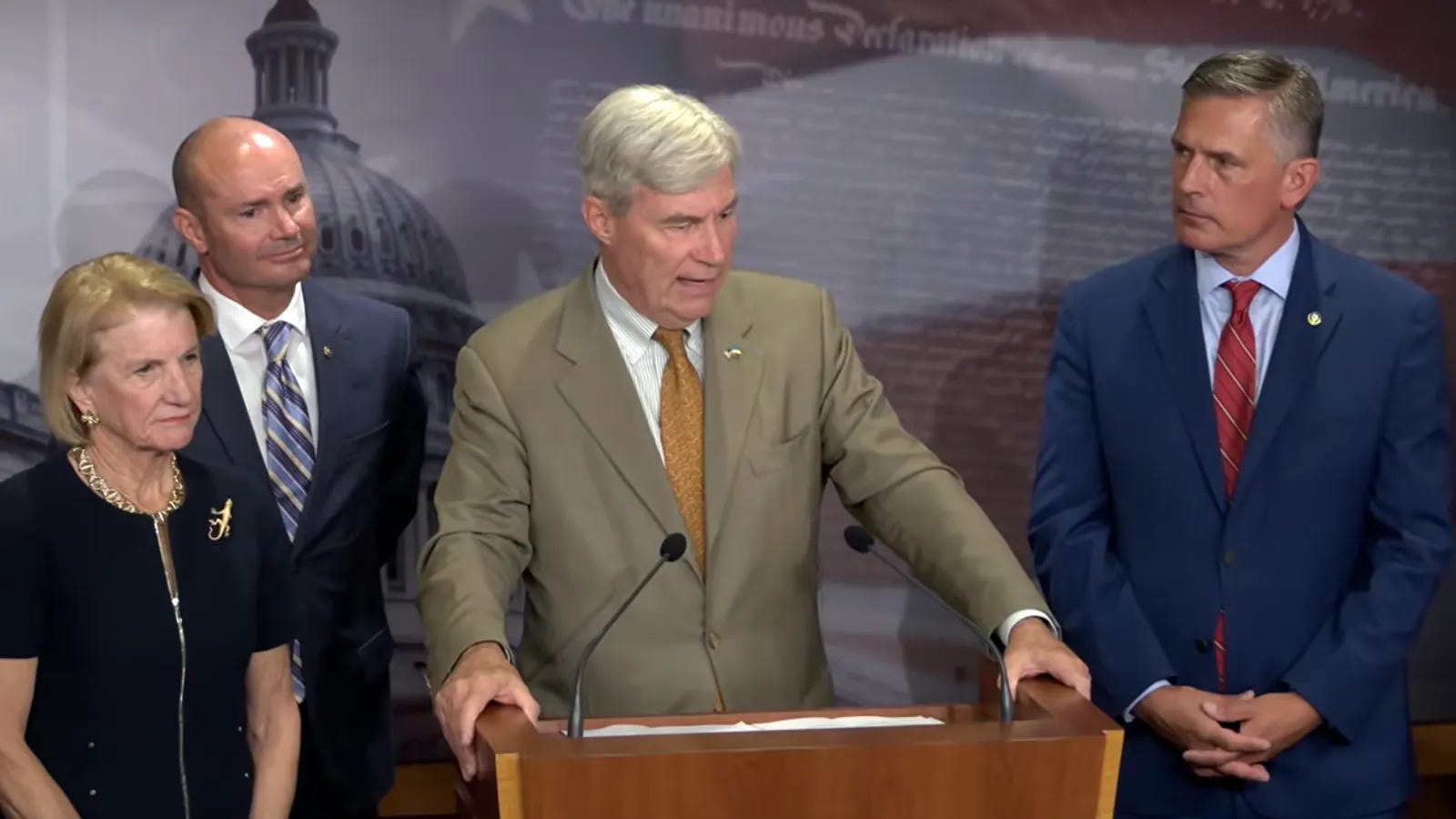
Congress has its best shot in years to build new sources of electricity – and the lines to carry them – faster, and it should take it before the year ends. Senators Capito, Whitehouse, Lee, and Heinrich just released the Bipartisan American Affordability and Jobs Act of 2026 (BAAJA) – a sweeping permitting reform deal that would end the self-imposed scarcity driving up electricity bills: our inability to build.
In 2022, more than 70 House Democrats signed a letter against Senator Manchin’s permitting package, calling it a “dirty deal” despite initial support from the Biden White House. It died, as did a second attempt in 2024. This time, both of the Democrats who negotiated the bill, Senators Whitehouse and Heinrich, are longtime climate champions who can make a stronger case to their caucus. This version can pass. Democrats should make sure it does.
Scarcity is a choice, and it is raising your electric bill.
Ezra Klein and Derek Thompson’s Abundance resonated the way it did last year because it named something a lot of people already felt. So many of the things that feel unaffordable, from rent to electricity, are things we don’t have enough of. And we don’t have enough because America has gotten very, very bad at building. We’ve passed ambitious laws and appropriated huge sums, only to watch projects sit in review for years while costs climb and Americans lose faith that anything can get done.
Most of us already understand the supply argument from everyday life. When there’s a shortage of eggs or oil, you pay more at the grocery store or the gas pump. But electricity is harder. Most people don’t think of power as something that can run short – except in emergencies – so a rising bill looks like something the utility alone is doing to you. But at the end of the day, it’s the same story: demand is growing, we haven’t built enough to keep up, and that’s why bills keep climbing.
Voters feel it. Our polling shows that 83% of voters are concerned about household electricity costs, with 79% saying their bills have gone up in the last two years.
So why aren’t we building enough? We’re using more electricity than ever, and the power plants and power lines we need to meet rising demand spend years waiting for approval before anyone can break ground. The most complex federal environmental reviews average 3.8 years, and some drag on past a decade. Then, even after that, opponents have up to six years to sue. Procedural environmental laws were drafted for an era when the danger was a dirty project getting built, not a clean one never getting built.
Now we have a suite of zero-carbon energy technologies that are waiting in line to get built, which, if deployed in abundance, would compete with and displace fossil fuel projects. Just look at China. It’s still the world’s largest emitter, and it’s still building coal plants. But it has also launched the biggest clean energy buildout in history, adding about 93 gigawatts of solar in a single month last year, nearly 100 panels per second. And now, for the first time in history, China’s carbon emissions are trending downward.
How the bill makes it easier to build the energy we need.
At its core, BAAJA clears the chokepoints that keep energy projects stuck.
It puts a clock on reviews and lawsuits. The bill sets deadlines for each step of a federal review and shrinks the window to sue from up to six years to 150 days. If a court finds a flaw, it sends the review back to the agency to fix, rather than stopping the project cold. Each year of delay adds cost, and for utility projects those costs land on customers.
It prevents delays and makes approvals stick. This is what wonks call permit certainty. Once a project clears review, no president should be able to cancel it for political reasons. When companies fear the next administration will pull the rug out, they either walk away or charge more to cover the risk. BAAJA bars federal agencies from stalling, canceling, or suspending a permit except for very narrow reasons. Agencies must give written notice, and if they can’t prove their case in court, they owe the project damages. And if agencies single out one kind of project for delays or denials, developers can take them to court for it.
It connects regions and strengthens the grid. When the grid can’t move cheap power to where people live, costlier and often dirtier energy runs instead, with both customers and the climate paying the difference. In 2024 alone, that came to an estimated $12 billion. BAAJA lets federal regulators approve interstate transmission lines after states have had a year to act. It also requires neighboring regions to plan together, and it makes sure customers who get no benefit from a line don’t get stuck paying for it. The transmission section is even bigger and better than Manchin’s deal: it makes utilities adopt technologies that get more out of the grid we already have and lets virtual power plants compete in electricity markets.
It makes data centers pay. Data center companies are willing to pay a premium to get a fast connection to a reliable energy source. BAAJA requires data centers to pay both for the already-existing grid and for any additional upgrades needed to accommodate the new load. That saves ratepayers money and holds data centers accountable for the energy they use.
Crucially, none of these reforms pick one type of energy over the other; the same rules apply to a solar or wind farm, a power line, and a gas pipeline. Climate advocates traditionally don’t like that, but that neutrality allows such a good deal to come together – and it’s also what most Americans want. Our polling shows that when asked who’s to blame for rising electricity prices, voters put politicians who pick favorite technologies at the top of the list and that more than two-thirds of voters support using every available source, including wind, solar, natural gas, and nuclear, to keep costs down and the lights on.
The modeling backs this up. Clean energy and transmission are disproportionately what’s stuck waiting to be permitted and built, so they have the most to gain from reform. Modeling by C2ES and Greenline Insights found the bill would cut power sector emissions 9 percent in the four regional grids they studied and save households $19 billion on electricity bills by 2040. Ultimately, the surest way to stop fossil fuel plants from running is to build clean power that’s cheaper.
Pass it in the lame duck.
All of that depends on actually getting this bill done, and the window is short. The Senate and House should pass BAAJA in the lame duck, the weeks between the November election and the start of the next Congress, rather than kicking it further down the road.
Committee rosters will change next year, and the path to a deal will get harder. Nobody should buy the argument that a Democratic-led chamber will lead to a better deal. Senators Whitehouse and Heinrich won big statutory changes that will stand the test of time since they’d be enacted on a bipartisan basis. They also used their leverage (and recruited Republican colleagues) to get the Trump Administration to commit to rolling back its attack on renewables. Whatever happens in November, a new Congress resets the clock and negotiations start over. And Donald Trump will still be president – with veto power.
This bill has trade-offs, as you’d expect from a bipartisan compromise in a polarized Washington, and Democrats should both acknowledge and accept them. But instead of racing to the bottom with lowest-common-denominator policies, negotiators took a different tack: they expanded the scope and took on hard problems. That is rare and courageous, and it deserves our applause. Too often, members of Congress look for excuses to vote no. Especially for big packages like this, it’s easier to vote no, blame the majority, accept the status quo, and claim you’ll do it better next time.
To get it done, the Senate will need to pass the bill as soon as it returns from recess, and then we need to focus on getting BAAJA through the House with enough Democratic votes. We already have good momentum there: the bipartisan Build America Caucus committed to seeing this bill across the finish line, the Blue Dog Coalition has endorsed it, and the New Democrats (representing 114 members) indicated they could be on board. That's a strong start. And a growing group of external stakeholders will help bring others along.
The coalition to get this bill across the finish line is stronger than ever. Labor unions have come out in support of the bill, including LiUNA, the United Association representing plumbers and pipefitters, as well as the International Union of Operating Engineers. Progressives have shown signs of coming on board. Environmental groups are still deliberating, but many have recognized the urgent need to build more clean energy and transmission.
If there ever was a perfect moment, this is as close as it gets. Passing the bill now lays the groundwork for the next Democratic president to actually see projects built during their term. These reforms are a prerequisite for future climate action.
This is what abundance looks like.
Not long ago, abundance was a side argument for wonks. Now it’s driving the biggest bills in Congress, because voters in both parties want lower costs, and more of them are connecting those costs to what we’ve failed to build. The 21st Century ROAD to Housing Act just became the biggest housing law in a generation because lawmakers stopped arguing over what they’d most like to see built and instead asked whether we could build at all. BAAJA asks the same question about energy, and people are noticing.

If Congress gets this done, the payoff goes well beyond the wonky words this debate tends to get stuck on, like “transmission” and “statute of limitations.” Those details matter, but they undersell what’s at stake.
Get this right, and the shift to clean energy speeds up. Factories go where power is cheap and reliable, so we bring more manufacturing and the jobs that come with it back home. Families can switch to electric cars and heat pumps that cost less to run than the gas versions, and their electric bill can go back to being a boring footnote in the budget. The grid holds up on the hottest days without mayors and governors having to ask everyone to cut back on AC. The air gets cleaner, because the plants we’re displacing are the dirtiest ones. And when something new comes along that needs a lot of power, the answer can be yes.
This is what abundance looks like: a country with so much energy that it’s never the limiting factor on anything we want to do.